Tampilkan postingan dengan label unemployment. Tampilkan semua postingan

Minggu, 08 Januari 2012

What Does 2012 Hold for Employment in the US?

Here is an excellent post by the Calculated Risk blog:
Question #5 for 2012: Employment

by CalculatedRisk

Earlier I posted some questions for next year: Ten Economic Questions for 2012. I'm trying to add some thoughts, and a few predictions for each question.

5) Employment: The U.S. economy added 1.64 million total non-farm jobs or just 137 thousand per month in 2011. There were 1.92 million private sector jobs added in 2011, or about 160 thousand per month. Although this was an improvement from 2010, this was still weak payroll growth for a recovery. How many payroll jobs will be added in 2012?

First a little "good" news. It appears that most of the state and local government job cuts will be over by mid year 2012. Just eliminating the employment drag from these job cuts will help.

from: Calculated Risk
Click to Enlarge

Here is a graph of the annual change in government payrolls since 1970. Over the last 3 year government employment has decreased significantly (this is a combination of Federal, State and local government). It appears job cuts will slow in the first half of 2012, and government employment might be neutral in the 2nd half of this year.

For 2011, the BLS reported 280 thousand government jobs lost, and my guess is this will slow to around 100 thousand in 2012 and most of the jobs lost will be in the first half of the year.

As predicted a year ago, construction employment increased in 2011. Although the increase was small - just 46 thousand jobs - this was the first increase for construction employment since 2006, and the first increase for residential construction employment since 2005.

I expect construction employment to increase at a faster rate in 2012 - not a boom - but better than in 2011. Unfortunately employment growth will probably slow in some other sectors. As an example, although auto sales will probably continue to increase in 2012, the rate of increase will slow since most of the recovery in auto sales has already happened. This suggests that private job creation will probably be about the same in 2012 as in 2011, even with some pickup in construction.

Private Payroll JobsHere is a graph of the annual change in private payrolls since 1970.

From: Calculated Risk
Click to Enlarge

Last year was disappointing given the high level of unemployment, but it was still the 2nd best year for private job creation since the 1990s.

My guess is private employment will increase around 150 to 200 thousand per month on average in 2012; about the same rate as in 2011.

With over 13 million unemployed workers - and 5.6 million unemployed for more than 26 weeks - adding 2 million private sector jobs will not seem like much of job recovery for many Americans. Hopefully I'm too pessimistic.
One of the tragedies of the "too small to succeed" stimulus of 2009 was that it didn't include enough money covering a long enough period to prevent the massive firing of state and local public workers including teachers, police, firement, etc. The Republicans have been intransigent on stimulating the economy because for them "job #1" was hurting the economy to prevent Obama being re-elected. They weren't interested in helping the 99% who are suffering from the greatest unemployment since the Great Depression or the ten million homes that were repossessed by the banks throwing people out onto the street. Their only concern is to make sure that the top 0.01% continue to make the multi-million incomes and hold on to the hundreds of millions and billions in wealth.

The only economic stimulus the Republicans believe in is the trickle down effect of activites such as the new boom in super-sized yachts. The only "jobs" that the ultra-rich want to hand on to are those personal service jobs where people "service" the rich for meagre wages while all the good wages, the middle class wages, disappear in the "new economy" that trickle down Reaganism has delivered over the last 30 years.

Senin, 12 Desember 2011

Stiglitz on the Great Recession

Here is a bit from an article in Vanity Fair by Nobel prizing-winning economist Joseph Stiglitz looking at the similarity between now and the 1930s. It is dismal reading:
The trauma we’re experiencing right now resembles the trauma we experienced 80 years ago, during the Great Depression, and it has been brought on by an analogous set of circumstances. Then, as now, we faced a breakdown of the banking system. But then, as now, the breakdown of the banking system was in part a consequence of deeper problems. Even if we correctly respond to the trauma—the failures of the financial sector—it will take a decade or more to achieve full recovery. Under the best of conditions, we will endure a Long Slump. If we respond incorrectly, as we have been, the Long Slump will last even longer, and the parallel with the Depression will take on a tragic new dimension.

Until now, the Depression was the last time in American history that unemployment exceeded 8 percent four years after the onset of recession. And never in the last 60 years has economic output been barely greater, four years after a recession, than it was before the recession started. The percentage of the civilian population at work has fallen by twice as much as in any post-World War II downturn. Not surprisingly, economists have begun to reflect on the similarities and differences between our Long Slump and the Great Depression. Extracting the right lessons is not easy.

...

The argument has been made that the Fed caused the Depression by tightening money, and if only the Fed back then had increased the money supply—in other words, had done what the Fed has done today—a full-blown Depression would likely have been averted. In economics, it’s difficult to test hypotheses with controlled experiments of the kind the hard sciences can conduct. But the inability of the monetary expansion to counteract this current recession should forever lay to rest the idea that monetary policy was the prime culprit in the 1930s. The problem today, as it was then, is something else. The problem today is the so-called real economy. It’s a problem rooted in the kinds of jobs we have, the kind we need, and the kind we’re losing, and rooted as well in the kind of workers we want and the kind we don’t know what to do with. The real economy has been in a state of wrenching transition for decades, and its dislocations have never been squarely faced. A crisis of the real economy lies behind the Long Slump, just as it lay behind the Great Depression.

For the past several years, Bruce Greenwald and I have been engaged in research on an alternative theory of the Depression—and an alternative analysis of what is ailing the economy today. This explanation sees the financial crisis of the 1930s as a consequence not so much of a financial implosion but of the economy’s underlying weakness. The breakdown of the banking system didn’t culminate until 1933, long after the Depression began and long after unemployment had started to soar. By 1931 unemployment was already around 16 percent, and it reached 23 percent in 1932. Shantytown “Hoovervilles” were springing up everywhere. The underlying cause was a structural change in the real economy: the widespread decline in agricultural prices and incomes, caused by what is ordinarily a “good thing”—greater productivity.

At the beginning of the Depression, more than a fifth of all Americans worked on farms. Between 1929 and 1932, these people saw their incomes cut by somewhere between one-third and two-thirds, compounding problems that farmers had faced for years. Agriculture had been a victim of its own success. In 1900, it took a large portion of the U.S. population to produce enough food for the country as a whole. Then came a revolution in agriculture that would gain pace throughout the century—better seeds, better fertilizer, better farming practices, along with widespread mechanization. Today, 2 percent of Americans produce more food than we can consume.

What this transition meant, however, is that jobs and livelihoods on the farm were being destroyed. Because of accelerating productivity, output was increasing faster than demand, and prices fell sharply. It was this, more than anything else, that led to rapidly declining incomes. Farmers then (like workers now) borrowed heavily to sustain living standards and production. Because neither the farmers nor their bankers anticipated the steepness of the price declines, a credit crunch quickly ensued. Farmers simply couldn’t pay back what they owed. The financial sector was swept into the vortex of declining farm incomes.

The cities weren’t spared—far from it. As rural incomes fell, farmers had less and less money to buy goods produced in factories. Manufacturers had to lay off workers, which further diminished demand for agricultural produce, driving down prices even more. Before long, this vicious circle affected the entire national economy.

The value of assets (such as homes) often declines when incomes do. Farmers got trapped in their declining sector and in their depressed locales. Diminished income and wealth made migration to the cities more difficult; high urban unemployment made migration less attractive. Throughout the 1930s, in spite of the massive drop in farm income, there was little overall out-migration. Meanwhile, the farmers continued to produce, sometimes working even harder to make up for lower prices. Individually, that made sense; collectively, it didn’t, as any increased output kept forcing prices down.

Given the magnitude of the decline in farm income, it’s no wonder that the New Deal itself could not bring the country out of crisis. The programs were too small, and many were soon abandoned. By 1937, F.D.R., giving way to the deficit hawks, had cut back on stimulus efforts—a disastrous error. Meanwhile, hard-pressed states and localities were being forced to let employees go, just as they are now. The banking crisis undoubtedly compounded all these problems, and extended and deepened the downturn. But any analysis of financial disruption has to begin with what started off the chain reaction.

...

The parallels between the story of the origin of the Great Depression and that of our Long Slump are strong. Back then we were moving from agriculture to manufacturing. Today we are moving from manufacturing to a service economy. The decline in manufacturing jobs has been dramatic—from about a third of the workforce 60 years ago to less than a tenth of it today. The pace has quickened markedly during the past decade. There are two reasons for the decline. One is greater productivity—the same dynamic that revolutionized agriculture and forced a majority of American farmers to look for work elsewhere. The other is globalization, which has sent millions of jobs overseas, to low-wage countries or those that have been investing more in infrastructure or technology. (As Greenwald has pointed out, most of the job loss in the 1990s was related to productivity increases, not to globalization.) Whatever the specific cause, the inevitable result is precisely the same as it was 80 years ago: a decline in income and jobs. The millions of jobless former factory workers once employed in cities such as Youngstown and Birmingham and Gary and Detroit are the modern-day equivalent of the Depression’s doomed farmers.

...

Can we actually bring ourselves to do this, in the absence of mobilization for global war? Maybe not. The good news (in a sense) is that the United States has under-invested in infrastructure, technology, and education for decades, so the return on additional investment is high, while the cost of capital is at an unprecedented low. If we borrow today to finance high-return investments, our debt-to-G.D.P. ratio—the usual measure of debt sustainability—will be markedly improved. If we simultaneously increased taxes—for instance, on the top 1 percent of all households, measured by income—our debt sustainability would be improved even more.

The private sector by itself won’t, and can’t, undertake structural transformation of the magnitude needed—even if the Fed were to keep interest rates at zero for years to come. The only way it will happen is through a government stimulus designed not to preserve the old economy but to focus instead on creating a new one. We have to transition out of manufacturing and into services that people want—into productive activities that increase living standards, not those that increase risk and inequality. To that end, there are many high-return investments we can make. Education is a crucial one—a highly educated population is a fundamental driver of economic growth. Support is needed for basic research. Government investment in earlier decades—for instance, to develop the Internet and biotechnology—helped fuel economic growth. Without investment in basic research, what will fuel the next spurt of innovation?

...

Americans in general are coming to understand what has happened. Protesters around the country, galvanized by the Occupy Wall Street movement, already know.
Shocking that greater productivity can cause an economic disaster. It should mean more goodies for everyone. But if you can't organize economic life in a way that everybody gets a fair share and decent opportunity, you are asking for a broken system that collapses around you. The Republicans and Democrats fail to address the fundamental problems of the current situation. Obama, the great hope of 2008, has been a complete bust, a flailing, useless, clueless fool who self-satisfiedly claimed he had done a "just right" stimulus as the economy flat-lined.

These are historic times and they require radical solutions under a leader of vision. Sadly the US has the oddly impassive Obama and the clearly incompetent and clueless Republican presidential candidates as the possible leaders after 2012. This says only one thing: the future will be incredibly bleak. There is a desperate need for a visionary leader with an understanding of economics and instead the US is stuck with buffoons and timid pretenders.

Jumat, 25 November 2011

The European Crisis

Here is a post by Paul Krugman on his NY Times blog. It is the latest in many attempts by him to get the European authorities to be sensible and do what economics requires rather than follow their emotions or "morality play" with counter-productive policies. Sadly, the Europeans are not listening:
Death By Hawkery

What the world needed in this global deleveraging crisis was deficit spending and higher inflation targets. What it got was fiscal austerity and obsessive concern with inflation risks that weren’t real. Hence the catastrophe now unfolding.

Judging from recent comments, many readers missed my earlier analyses on these issues — I’m still getting the “You idiot, debt got us into this mess, how can debt get us out?” type of comment. So let me re-repost my discussion of this whole issue in full, followed by a couple of brief notes on the European situation.

The original post:

Sam, Janet, and Fiscal Policy

One of the common arguments against fiscal policy in the current situation – one that sounds sensible – is that debt is the problem, so how can debt be the solution? Households borrowed too much; now you want the government to borrow even more?

What’s wrong with that argument? It assumes, implicitly, that debt is debt – that it doesn’t matter who owes the money. Yet that can’t be right; if it were, we wouldn’t have a problem in the first place. After all, to a first approximation debt is money we owe to ourselves – yes, the US has debt to China etc., but that’s not at the heart of the problem. Ignoring the foreign component, or looking at the world as a whole, the overall level of debt makes no difference to aggregate net worth – one person’s liability is another person’s asset.

It follows that the level of debt matters only if the distribution of net worth matters, if highly indebted players face different constraints from players with low debt. And this means that all debt isn’t created equal – which is why borrowing by some actors now can help cure problems created by excess borrowing by other actors in the past.

To see my point, imagine first a world in which there are only two kinds of people: Spendthrift Sams and Judicious Janets. (Sam and Janet who? If you’d grown up in my place and time, you’d know the answer: Sam and Janet evening / You will see a stranger … But actually, I’m thinking of the two kinds of agent in the Kiyotaki-Moore model.)

In this world, we’ll assume that no real investment is possible, so that loans are made only to finance consumption in excess of income. Specifically, in the past the Sams have borrowed from the Janets to pay for consumption. But now something has happened – say, the collapse of a land bubble – that has forced the Sams to stop borrowing, and indeed to pay down their debt.

For the Sams to do this, of course, the Janets must be prepared to dissave, to run down their assets. What would give them an incentive to do this? The answer is a fall in interest rates. So the normal way the economy would cope with the balance sheet problems of the Sams is through a period of low rates.

But – you probably guessed where I’m going – what if even a zero rate isn’t low enough; that is, low enough to induce enough dissaving on the part of the Janets to match the savings of the Sams? Then we have a problem. I haven’t specified the underlying macroeconomic model, but it seems safe to say that we’d be looking at a depressed real economy and deflationary pressures. And this will be destructive; not only will output be below potential, but depressed incomes and deflation will make it harder for the Sams to pay down their debt.

What can be done? One answer is inflation, if you can get it, which will do two things: it will make it possible to have a negative real interest rate, and it will in itself erode the debt of the Sams. Yes, that will in a way be rewarding their past excesses – but economics is not a morality play.

Oh, and just to go back for a moment to my point about debt not being all the same: yes, inflation erodes the assets of the Janets at the same time, and by the same amount, as it erodes the debt of the Sams. But the Sams are balance-sheet constrained, while the Janets aren’t, so this is a net positive for aggregate demand.

But what if inflation can’t or won’t be delivered?

Well, suppose a third character can come in: Government Gus. Suppose that he can borrow for a while, using the borrowed money to buy useful things like rail tunnels under the Hudson. The true social cost of these things will be very low, because he’ll be putting resources that would otherwise be unemployed to work. And he’ll also make it easier for the Sams to pay down their debt; if he keeps it up long enough, he can bring them to the point where they’re no longer so severely balance-sheet constrained, and further deficit spending is no longer required to achieve full employment.

Yes, private debt will in part have been replaced by public debt – but the point is that debt will have been shifted away from severely balance-sheet-constrained players, so that the economy’s problems will have been reduced even if the overall level of debt hasn’t fallen.

The bottom line, then, is that the plausible-sounding argument that debt can’t cure debt is just wrong. On the contrary, it can – and the alternative is a prolonged period of economic weakness that actually makes the debt problem harder to resolve.

European twists

The European mess is pretty well described by the story above, with the Sams mainly in the periphery and the Janets in the core; what we’re getting is forced austerity in the periphery with no offsetting expansion in the core, and now everyone is shocked, shocked that the whole continent seems headed for recession.

In Europe’s case, however, higher inflation is even more crucial than for the United States — because Europe also needs a large adjustment of relative prices that will be very hard if not impossible to achieve with low overall inflation.

So as of this morning, the 5-year German breakeven — an implicit forecast of inflation — is only 0.9%.

This is not going to work.
Sadly the American authorities are facing a similar deflationary situation and are just now embarking on the same idiocy as the Europeans: austerity. It will fail in the US just like it is failing in Europe. It is the standard "prescription" of the political right, but it is profoundly ignorant of economic reality and what is required. People will suffer and pay a very dear price for the idiocy of politicians. It is a lost decade just like the Japanese have suffered through. Tragic.

... and here is more despair by Krugman at the idiocy of the politicians (and the "serious people" in positions of authority like the Bank of England, the Federal Reserve, and the European Central Bank):
Death By Accounting Identity

Martin Wolf has a somewhat despairing-sounding column this morning, in effect pleading with the Cameron government to admit that the laws of arithmetic must apply. Good luck with that.

Martin writes,
If the private sector is seeking to run down its debts, it is hard for the government to do so, too, because everybody cannot spend less than their income. That is the “paradox of thrift”. No, it is not a novel idea.
Ah, but for the past two years leaders in the Eurozone, Britain, and the US Republican party have subscribed to the following plan:

1. Slash government spending

2. ??????

3. Prosperity!

For a while ???? was framed in terms of the doctrine of expansionary austerity: slash spending and the confidence fairy would make private-sector spending rise. At this point, however, few still believe in this doctrine. Also, in the euro area it was hard to see how things would work even if the confidence fairy made an appearance; how was that supposed to resolve the large payments imbalances between the core and the periphery?

But even as the intellectual foundations, such as they were, for the austerity plan have been demolished, the plan itself remains unchanged.
I never thought I would live such an era of unrelieved idiocy. But knowing a little history, I was foolish to think I could avoid it. In my young adulthood I watched the US condemn an entire generation of young men to a meaningless and unwinnable war in Vietnam simply because no president had the courage to admit that the war was a mistake and end it. In my early childhood I watch as nutty right wing politicians tore the US to pieces in a mad witch hunt of "communists". I saw sleazy people like Nixon build a career on this evil enterprise. In my working years I watched as people fell in love with the rich and flocked to watch Lifestyles of the Rich and Famous. These sad fools didn't realize they were idolizing the social parasites who were busy from 1980 until today sucking the life blood out of society so they could live a life of mad indulgence while the bottom 99% saw their lives stagnate, saw the economy enter a depression caused by fraud and criminality by the greed of bankers, and saw a hopeful new president be elected and fail to act because he too was madly in love with the rich and unable and unwilling to help the bottom 99%. My life has been lived in an unremitting horror story of cruelty, greed, fear, and ignorance. That is the history of humanity for the last 10,000 years. Tragic.

Rabu, 19 Oktober 2011

The Ultimate IP Sleaze from Obama

The "people's" president is supposed to be on the side of the people. Everybody understands that Republican presidents cater to the 1% and those wingnuts who aspire to be the 1%. But for everybody else there is only one choice: the Democratic president.

Obama is pushing his "jobs" agenda, but with great irony, he wants creative graphic designers to labour for free to create him a poster. No job for them. Just the glory of knowing that "they did it for a good cause". Oh yeah...

Here is a bit from a post in Rolling Stone magazine:
The Obama campaign has more than $60 million cash on hand. In an economy this bad, you'd think a presidential campaign that flush would be happy to pay good money for a talented designer to create a campaign poster.

But the folks at Obama campaign have taken a page from the Arianna Huffington book of economic exploitation and called on "artists across the country" to create a poster ... for free.

And here's the kicker. It's a jobs poster.

Yes, the Obama campaign is soliciting unpaid labor to create a poster "illustrating why we support President Obama's plan to create jobs now, and why we'll re-elect him to continue fighting for jobs for the next four years."

If you win? You get: A framed copy of your own poster, signed by the president ("approximate retail value $195").

And if you don't win? Well, that's too bad. You've not only lost the contest, you've also surrendered your intellectual property. "All submissions will become the property of Obama for America," according to the fine print.
Just like the Obama presidency knows that his job #1 is to bailout banks and make sure billionaire bankers get their humungous bonuses, the Obama presidency knows that intellectual property rights (IP) goes to the sleazeball who can squeeze it out of the dumb proletariat who will sign up for work for free and give up all rights to their ideas. Wow. Isn't capitalism great, or what? Obama is a typical 1% type, you work, he gets the money, the glory, the top job, the babes, the media, the big retirement package. You get to hang on to your warm-and-fuzzy feeling that you "helped". That and $5 will help you buy a hamburger to split with your wife and 3 kids.

Obama wants to create jobs... he wants to create 4 more years for No. 1. For the 99%? This is just a slogan. He is going through the motions, crafting this as a "message with spin and a careful political game of partisanship". Whether you get a job or not? He could care less. That's your problem, not his. He is the president for the 1%.

Selasa, 18 Oktober 2011

Self-Inflicted Helplessness

The political and monetary authorities have behaved wonderfully since the 2008 collapse. They are shown brilliantly the technique called learned helplessness. Or so the story goes.

In truth, the leaders have simply ignored their responsibility and their capability and are abetted by their enablers, the media. Here's a bit by Dean Baker on his Beat the Press blog pointing this out:
The Post Wrongly Tells Readers That Central Banks Can't Do More to Boost Growth

In an article about the IMF reversing its pro-austerity stance, the Post told readers:

"Central banks, which have already reduced interest rates to extremely low levels, have little remaining ability to boost economic activity."

This is not true. Central banks could explicitly target higher rates of inflation. This would lower real interest rates and reduce debt burdens. This policy has been advocated by many prominent economists, including Paul Krugman, Ken Rogoff, the former chief economist of the IMF, and Ben Bernanke when he was still a professor at Princeton.
I'm reading Sylvia Nasar's Grand Pursuit and it really, really sad to realize that this same flailing about and impotence in the face of a crying need for action marked the 1930s as it does today. It simply means that tens of millions suffer because the "leaders" can't lead. Instead the leaders are fearful of "little voices" in their heads whispering about dreaded inflation or the need to appease some hidden actor requiring "confidence". Even in the 1930s there were a number of leading economists, Keynes being the preeminent example, who properly diagnosed the situation and gave political and monetary authorities the needed guidance. But then, as now, these "leaders" simply ignored the advice and played their hand as if the economy were a morality play requiring "excesses" to be punished by many, many years of suffering by the innocent, the unemployed workers with absolutely no responsibility for the crash.

Senin, 17 Oktober 2011

A Day Late and a Dollar Short

The "poltics" in America is pathetic. Nobody is addressing the real needs. The major parties are playing a three card monte game with posturing and distractions. This day late and a dollar short politics has got to end.

Here's a bit from a relevant Robert Reich post:
Republicans are debating again tomorrow night. And once again, Americans will hear the standard regressive litany: government is bad, Medicare and Medicaid should be cut, “Obamacare” is killing the economy, undocumented immigrants are taking our jobs, the military should get more money, taxes should be lowered on corporations and the rich, and regulations should be gutted.

Four years ago the most widely-watched TV debate among Republican aspirants attracted 3.2 million viewers. This year it’s almost twice that number. And for every viewer assume a multiplier effect as he or she shares what’s heard with friends and family.

Americans are listening more intently this time around because they’re hurting and they want answers. But the answers they’re getting from Republican candidates – tripping over themselves trying to appeal to hard-core regressives – are the wrong ones.

The correct ones aren’t being aired.

That’s partly because there’s no primary contest in the Democratic party. So Republicans automatically get loads of free broadcast time to air their regressive nonsense while the Democrats get none.

But even if the President had equal time, the debate about what to do about the crisis would still be frighteningly narrow.

That’s because the President’s answers don’t nearly match up to the magnitude of the crisis.

Without bold alternatives, Americans desperate for big solutions are attracted to bold crackpot ideas like Herman Cain’s “9-9-9” proposal, which would raise taxes on the poor and cut them for the rich.

This is where the inchoate Occupy Wall Street movement could come in. What’s needed isn’t just big ideas. It’s people fulminating for them – making enough of a ruckus that the ideas can’t be ignored. They become part of the debate because the public demands it.

The biggest thing the President has proposed is a plan to create 2 million jobs. But that’s not nearly big enough. Today, 14 million Americans are out of work, and 11 million more are working part-time who’d rather be working full time.

The nation needs a real jobs plan, one of sufficient size and scope to do the job – including a WPA and a Civilian Conservation Corps, to put the millions of long-term unemployed and young unemployed to work rebuilding America.
I'm reading material from the 1930s and we've been down this path before. The politics is a distraction. We know how to fix the economy. It takes a big jolt of spending to fix the huge number of people caught in a credit squeeze. Pussyfooting around only stretches out the pain. Most politicians know this, but they aren't honest with the public. They would rather play their games and go for personal gain rather than do their duty and build a better tomorrow.

Sabtu, 08 Oktober 2011

More Proof that Education in America is Failing

From Dean Baker's Beat the Press blog:
Speaker Boehner Commits Huge Gaffe, Can't Do Simple Arithmetic

Republican House Speaker John Boehner committed an enormous gaffe yesterday according to a Washington Post article. Mr. Boehner claimed that:

"Our unemployment rate has been higher than 8 percent for more than 21 / 2 years, far above what the Obama administration promised with the ‘stimulus.'”

Actually, the stimulus did not promise to keep the unemployment rate below 8 percent as Mr. Boehner would know if he ever looked at the administration's discussion of its stimulus proposal at the time. The report claimed that the stimulus as proposed would create between 3-4 million jobs by the end of 2010. However, the bill passed by Congress was substantially smaller than the stimulus requested by the president. The expected effect would therefore be in the range of 2-3 million jobs.

However, the economy was in much worse shape than the administration recognized at the time. It expected the unemployment rate to peak at 9.0 percent even without any stimulus. At the time, the economy was losing close to 700,000 jobs a month. The unemployment rate had already risen to 9.4 percent by May when the first stimulus related checks were just going out the door.

The best evidence available shows that the stimulus worked almost exactly as planned, creating 2-3 million jobs. However, the economy needed 10-12 million. The Obama administration's error was in underestimating the severity of the downturn, not overpromising for the benefits of the stimulus.

This is apparent to people who can read and know arithmetic. The Washington Post should have highlighted the fact that Mr. Boehner apparently either has difficulty with arithmetic or was deliberately trying to mislead the public.
Call me cynical, but I believe that somebody who gets a B.A. degree in Business Administration from the private Xavier University probably has math skills greater than a 5th grader. So my best guess is that Boehner is lying through his teeth for partisan advantage. He is part of the problem and not the solution. It is liars and cheats like Boehner who are destroying America.

I don't think education in America is failing. I think politics and politicians in America are failing. They are sold out to Wall Street and the ultra-rich. They politicians are bought and sold among the elite to do the bidding of the elite but hide behind stories that twist the truth and confuse the electorate.

Kamis, 06 Oktober 2011

Reich Gives the Low Down on the "New Economy"

Since 1980 the Republicans have sold Americans on a "trickle down" economy that gave big tax cuts to the "job creators" with the promise that the bottom 99% would soon be drowning in high-paying jobs unleashed by the "entrepreneurial creativity" of the rich. With unemployment headed for 10% and many millions recently homeless due to foreclosure, many wonder where that "trickle down" miracle supposedly delivered. Who got the big bucks?

Here's Robert Reich spilling all the beans:

Minggu, 02 Oktober 2011

US Unemployment

Here is a nice picture from Richard Green at USC:

Click to Enlarge

Green states:
Cuts in state and local government jobs (police officers, school teachers, firefighters, DMV workers) are putting a drag on employment growth. Moreover, this picture understates the problem, because total compensation to many state and local workers has been cut.
The US federal government needs a stimulus to both hire directly via a WPA program as well as to fund state and local authorities to re-hire teachers, police, firefighters, etc.

Sadly, the idiotic right wing party, the Republicans, are more interested in wrecking the economy so they can blame Obama and win the 2012 election than they are in saving the country for its citizens. Personally, I think the Republicans should be arrested for economic crimes -- condemning 25 million to unemployment and the loss of homes through foreclosure -- so that politicians who are interested in solving America's problems can step forward and put the country back on a path of progress.

Rabu, 14 September 2011

Shadow Boxing with Obama

Obama is rigorously exercising his ability to box shadows. He's on the road pounding the message home -- two years and 8 months after becoming president -- that jobs is "issue #1" and is a crisis.

Funny... he didn't notice this crisis back in January 2009 when 800,000 jobs a month were being lost. He didn't notice it during the two years after March 2009 while he crowed that his stimulus was "just right" and that America was on the road to "recovery".

But now he's working on his left jab and his powerful right uppercut. Ready to lay out anybody who would complain that he wasn't "on the job".

Sadly... while he boxes shaddows, the real government in the US is going about slicing and dicing peoples' future. Here's Robert Reich's take:
If governors try hard enough, though, they can create lots of lousy jobs. They can drive out unions, attract low-wage immigrants, and turn a blind eye to businesses that fail to protect worker health and safety.

Rick Perry seems to have done exactly this. While Texas leads the nation in job growth, a majority of Texas’s workforce is paid hourly wages rather than salaries. And the median hourly wage there was $11.20, compared to the national median of $12.50 an hour.

Texas has also been specializing in minimum-wage jobs. From 2007 to 2010, the number of minimum wage workers there rose from 221,000 to 550,000 – that’s an increase of nearly 150 percent. And 9.5 percent of Texas workers earn the minimum wage or below – compared to about 6 percent for the rest of the nation, according to the Bureau of Labor Statistics. The state also has the highest percentage of workers without health insurance. Texas schools rank 44th in the nation in per-pupil spending.

The Perry model of creating more jobs through low wages seems to be catching on around America.

According to a report out today from the Commerce Department, the median income of U.S. households fell 2.3 percent last year – to the lowest level in fifteen years (adjusted for inflation). That’s the third straight year of declining household incomes. Part of this is loss of jobs. Part is loss of earnings.
The problem with America is too many politicians are busy getting their own job security and not given a damn about the "average Joe". Too many politicians are at the beck and call of billionaires but are missing in action for the bottom 90%.

Minggu, 11 September 2011

Strong on Tone, Short on Substance

Here is a chat by Felix Salmon with a another reporter at Reuters providing their instant reaction to Obama's "jobs" speech:


I liked the bit:
Not enough direct hiring to make a dent in unemployment.
Yep... so much for "jobs".

US Employment Picture

Here is a nice graph from David Altig's Macroblog of the Atlanta Federal Reserve:

Click to Enlarge

The only healthy employment is in the service economy: education and health care. That is almost as bad a foundation for an economy as the ponzi scheme of selling houses to each other at ever higher prices which was the US strategy of 2002-2007.

Manufacturing has had a millstone around its neck for the last decade. America as an industrial giant is fast disappearing. Construction and government jobs used to be a reliable employment sector but have been trying to tread water but are in fact slowly sinking since early 2009. The "temp help" business is the only current "strength" in the US economy.

And into that mix this week came Barack "Jobs" Obama with his $450 billion tiny thumb to plug a leak in a vast oceanic dyke, the $10 trillion dollars of lost wealth and income since 2008.

What happened to the "can do" America? The pragmatic America? The cut out the crap and get the job done America?

Sabtu, 10 September 2011

I Can't Believe It... Maureen Dowd is Accusing Politicians of "Faking It"

Here's a bit from a NY Times op-ed by Maureen Dowd:
WOW, what a relief.

The president was strong and House Republicans were conciliatory.

There was only one teensy-weensy problem: The president is weak and House Republicans are obstructionist.

Congressional Republicans, heeding polls indicating that their all-out assault on President Obama was risky, finally tempered their public comments after the jobs speech on Thursday and stopped acting like big jerks.

Obama, heeding plummeting polls and beseeching voices from his despairing base, finally deigned to get tough.

In the capital of political tactics, it was just another fine day of faking it.
Oh my gosh... Maureen Dowd thinks the politicians may be faking it.

I feel Obama really does have fire in his belly. He really feels the need to get jobs for the unemployed. Why else would have have waited for over two years to finally get up and give "the big speech"? Why would he have waited for the summer recess before getting around to giving his impassioned cry? Why would he have decided that he could cool his heels for 24 hours while Republican presidential candidates had a love fest in California? He knows this is an urgent issue with 25 million unemployed and underemployed waiting for action. So he's planned his moment.

Oh... and he's decided to respond with big numbers and big action. There's a $10 trillion hole. So Obama has given it his all and decided to call on Congress to belly up with $450 billion. Yep... that's 4.5% of the missing spending in the economy. That should fill that hole nicely. Oh... and rather than just go out and hire people. Obama has decided those darn Republicans did such a bang-up good job of managing the economy over the last 30 years and left the bottom 90% with so much loose cash and happy times, that he has decided to continue with the "most of this stimulus will be tax reductions for business" because we all know that "trickle down" economics is really, really effective.

Since Obama has now officially "caught fire" in a jobs, jobs, jobs push. He has decided he can best show off his leadership style with his renowned "lead from behind" so he put this challenge to the populace:
A re-energized Obama urged students at the University of Richmond to lobby lawmakers: “I want you to call, I want you to e-mail, I want you to tweet, I want you to fax, I want you to visit, I want you to Facebook, send a carrier pigeon.”
Right. Why send a man to do a man's job when you can send some fresh-faced youth out to fight your fight? That's shows the leadership savvy of Obama. He knows that a general always leads from behind.

Yep... this is the bold brassy Obama, the promised one:
As always, the same questions persist in our long, fruitless effort to pierce the Obama opacity. How long can the president sustain the sizzle before the fizzle? Does he get it together when the country’s in trouble or when he’s in trouble?

Certainly, Obama cares that Americans are in pain. Yet he has been unable to move away from his academic disdain for hardball and his alpha addiction to buzzer-beating wins.

So while the country has grown ever more scared, miserable, broke and broken, the president has too often been absent, quiet, ambivalent, impenetrable and inscrutable.

The master of his own narrative in print let the Republicans define the narrative in politics. And Obama likes to come in late, after the other players have staked out positions. It’s a strangely risk-averse tact, given the fact that he took two of the boldest risks in history — jumping into the presidential race in the first place and giving the kill order on Bin Laden on sketchy intelligence.

But when his polls plummeted, the Sleeping Beauty President roused himself to transform back into a semblance of the 2008 electrifying phenomenon.

He always must be chided and cajoled before he gets re-engaged.

...

Each time Obama goes through a period of lying doggo, his opponents — from Hillary in the primaries to the Tea Party in the summer of 2009 to the House Republicans during the debt-ceiling debacle — get an infusion of oxygen.

The reawakened Republicans are no longer the loyal opposition. They’re revolutionary Bolsheviks who want to eat Obama alive.

When the president stays insulated with his little circle that doesn’t know how to push his messages, and he lets the nihilist Republicans go unchallenged in their crazy claims to be saving the country they’re hurting, he sets the stage for Rick Perry.

It’s still impossible to sum up what Obama’s presidency is about right now, except saving his own job.
Yeah... there's nothing quite as inspiring as a "leader" who only shows up with his fight face on when his job is at stake. It shows his deep "commitment" to the American people.

The New "Jobs, Jobs, Jobs" Obama

The economist and blogger Mark Thoma whose Economist's View blog has recorded his opinion of Obama's big "jobs" address to Congress. He tries to remain a good "team player" and emphasize the positive, but he is worried by a few things:
However, there are some concerns. First, the speech itself lost its focus on job creation toward the end. Instead of jobs, the speech talked about the deficit, red tape regulation, the need to accept painful cuts in social programs, and so on — all favorite GOP issues. If that’s an indication that the commitment toward job creation will be similarly derailed by these issues in the future, then that’s worrisome.

Second, and more importantly, I didn’t like the way the package would be paid for:
The agreement we passed in July will cut government spending by about $1 trillion over the next ten years. It also charges this Congress to come up with an additional $1.5 trillion in savings by Christmas. Tonight, I’m asking you to increase that amount so that it covers the full cost of the American Jobs Act. …

So we can reduce this deficit, pay down our debt, and pay for this jobs plan in the process.
Too many of the proposed budget cuts are front-loaded already, and this would likely make it worse. It would be much better to pay for the package when the economy is on better footing. Paying for a significant portion of the job creation bill immediately, e.g. in 2013 and 2014 (as would likely be a condition of it passing Congress), will offset some of the stimulus and make it less effective
Sadly, those who were sold in 2008 by candidate "The Audacity of Hope" Obama have discovered the 2011 president "I'm terrified of the Republicans" Obama. Nobody in 2008 thought they were voting in the 2011 model. They were duped. They were promised "change you can believe in" and ended up being delivered "whatever petty changes I can convince the Republicans to give me". So much for elections and for politicians. Obama ended up being a pig in a poke.

Fool me once, shame on you. Fool me twice, shame on me. Obama is going to find it very, very hard to gather those enthusiastic "hope" and "change you can believe in" crowds in 2012. I guess he will have to sell his campaign on fear: if you don't vote me in with my give the Republicans what they want but drag it out and make it painful, then you will be electing Republicans and they will sell your momma into slavery so they can give the rich folks one more big tax break.

Minggu, 04 September 2011

Robert Reich's Lament for the Passing of the Middle Class

America has become of, by, and for the rich. No more silliness about government of the people, by the people, for the people. Nope. It is now reduced to the modern essentials: government for the rich.


From a post by Robert Reich on his blog:

The economy won’t really bounce back until America’s surge toward inequality is reversed. Even if by some miracle President Obama gets support for a second big stimulus while Ben S. Bernanke’s Fed keeps interest rates near zero, neither will do the trick without a middle class capable of spending. Pump-priming works only when a well contains enough water.


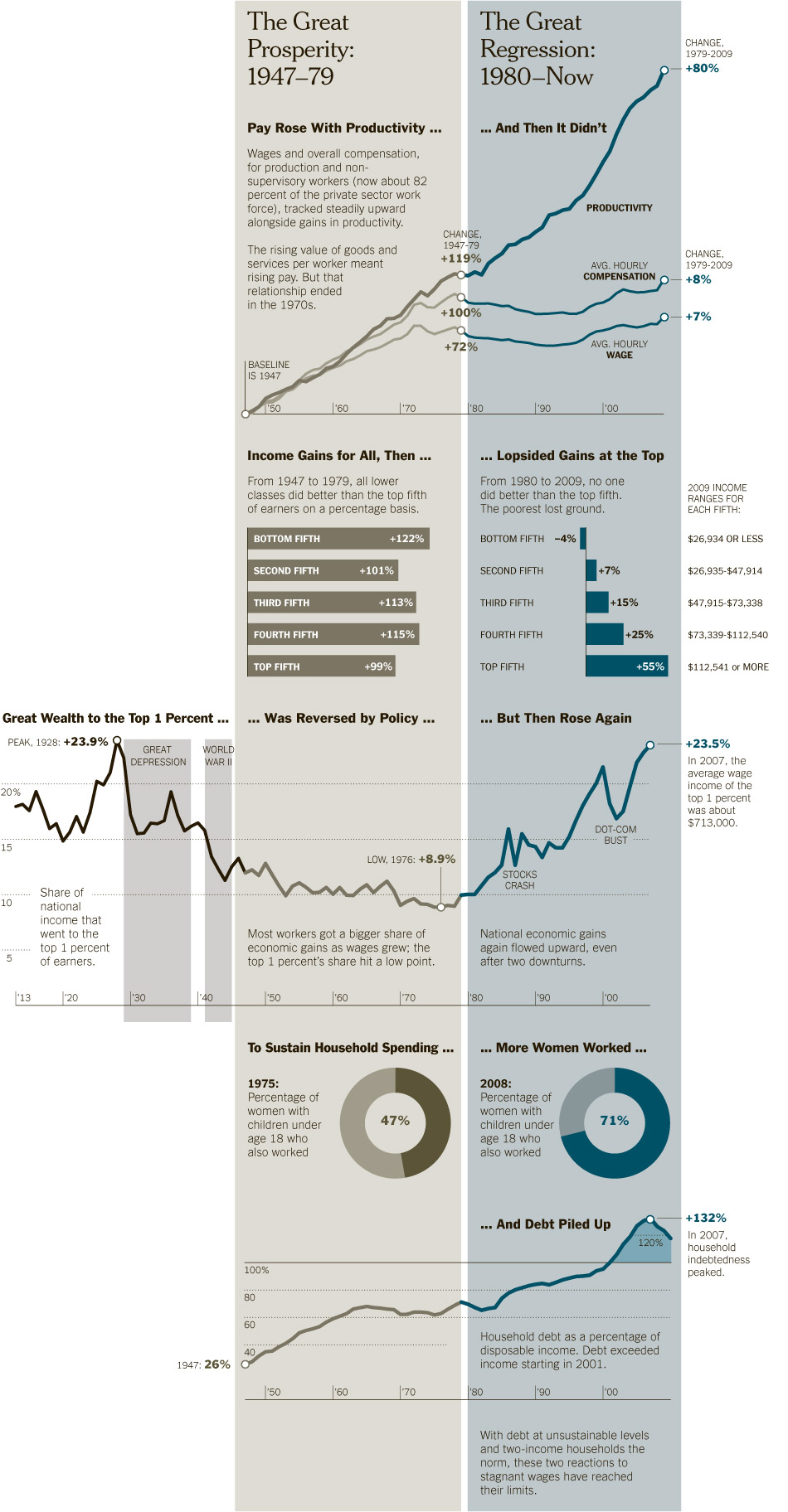
Look back over the last hundred years and you’ll see the pattern. During periods when the very rich took home a much smaller proportion of total income — as in the Great Prosperity between 1947 and 1977 — the nation as a whole grew faster and median wages surged. We created a virtuous cycle in which an ever growing middle class had the ability to consume more goods and services, which created more and better jobs, thereby stoking demand. The rising tide did in fact lift all boats.


During periods when the very rich took home a larger proportion — as between 1918 and 1933, and in the Great Regression from 1981 to the present day — growth slowed, median wages stagnated and we suffered giant downturns. It’s no mere coincidence that over the last century the top earners’ share of the nation’s total income peaked in 1928 and 2007 — the two years just preceding the biggest downturns.


Starting in the late 1970s, the middle class began to weaken. Although productivity continued to grow and the economy continued to expand, wages began flattening in the 1970s because new technologies — container ships, satellite communications, eventually computers and the Internet — started to undermine any American job that could be automated or done more cheaply abroad. The same technologies bestowed ever larger rewards on people who could use them to innovate and solve problems. Some were product entrepreneurs; a growing number were financial entrepreneurs. The pay of graduates of prestigious colleges and M.B.A. programs — the “talent” who reached the pinnacles of power in executive suites and on Wall Street — soared.


The middle class nonetheless continued to spend, at first enabled by the flow of women into the work force. (In the 1960s only 12 percent of married women with young children were working for pay; by the late 1990s, 55 percent were.) When that way of life stopped generating enough income, Americans went deeper into debt. From the late 1990s to 2007, the typical household debt grew by a third. As long as housing values continued to rise it seemed a painless way to get additional money.


Eventually, of course, the bubble burst. That ended the middle class’s remarkable ability to keep spending in the face of near stagnant wages. The puzzle is why so little has been done in the last 40 years to help deal with the subversion of the economic power of the middle class.

I don't see much hope for America. There should be political revolts against the current downward trend. Instead, the ultra-rich have cleverly used the media to build astro-turf groups to agitate for pro-ultra-rich policies, more tax cuts, more deregulation, more anti-worker laws, the destruction of social safety nets, etc.

Small Facts... Often Ignored

From a post by John Mauldin at The Big Picture blog:

The US has roughly the same number of jobs today as it had in 2000, but the population is well over 30,000,000 larger. To get to a civilian employment-to-population ratio equal to that in 2000, we would have to gain some 18 MILLION jobs.
And this:

Note that simply to reduce the unemployment rate to 8% over two years at the lowest participation rate of 64% would require 157,000 jobs a month. If those jobs started showing up, the number of people looking for jobs would increase, thus increasing the “official” unemployment rate. Most of the numbers of required new jobs are simply not possible, if history is any guide. (This is a politician’s nightmare. It will be years before they can take credit for something they didn’t do.)

Here's what happens when right wing governments that push for "deregulation" allow the big Wall Street banks to do "financial engineering" and destroy everybody's retirement fund:


Click to Enlarge


And, of course, nobody from the Wall Street banks has gone to jail. They caused a $10 trillion implosion, but golly gee, nobody did anything wrong!


For those who like that facts in pictures and not words, here is a chart from a different post on The Big Picture blog.

Jumat, 02 September 2011

The American Economic Mess in a Nutshell

Robert Reich sums up the problem facing the US:

Since this Depression began at the end of 2007, America’s potential labor force – working-age people who want jobs – has grown by over 7 million. But since then the number of Americans with jobs has shrunk by more than 300,000.


If this doesn’t prompt President Obama to unveil a bold jobs plan next Thursday, I don’t know what will.


The problem is on the demand side. Consumers (whose spending is 70 percent of the economy) can’t boost the economy on their own. They’re still too burdened by debt, especially on homes that are worth less than their mortgages. Their jobs are disappearinig, their pay is dropping, their medical bills are soaring.


And businesses won’t hire without more sales.


So we’re in a vicous cycle.

Nearly 3 years have been wasted without taking the fact that the US is in a serious depression. Obama is fiddling while Rome burns. The Republicans are spitting in the eye of America with their fantasy story that more Bush tax cuts and deregulation will raise the economy from the dead. The George Bush years were the worst for job creation since WWII. Even Jimmy Carter in 4 years created more jobs during the 1970s stagflation that George Bush did in 8 years of his "deregulate, deregulate, deregulate" and "shrink the government".


I wish Obama would listen to Robert Reich:

So why don’t Republicans get it? Either they’re knaves – they want the economy to stay awful through next Election Day so Obama gets the boot. Or they’re fools – they’ve bought the lie that reducing the deficit now creates more jobs.


Every time you hear anyone say we’re “broke” or “can’t afford to spend more,” tell them we’ll be in worse shape if we don’t. If the economy remains dead in the water, the ratio of public debt to GDP balloons.


And remind them that the federal government can now borrow at fire-sale rates. Interest on the ten-year Treasury bill is 2 percent.


Do you hear me, Mr. President? Please — be bold next week. And if, as expected, Republicans refuse to go along, take it to the people. Mobilize the public. Use the bully pulpit. That’s what you have it for.

Kamis, 01 September 2011

Republican Mismanagement of the US Economy

What I find ludicrous is how the Republicans want to lecture the Democrats and Obama about "economics" and "budgets" and "deficits and debts".


Here is a bit from an article by Nobel prize-winning economist Joseph Stiglitz in Project Syndicate:

Even if Bush could be forgiven for taking America, and much of the rest of the world, to war on false pretenses, and for misrepresenting the cost of the venture, there is no excuse for how he chose to finance it. His was the first war in history paid for entirely on credit. As America went into battle, with deficits already soaring from his 2001 tax cut, Bush decided to plunge ahead with yet another round of tax “relief” for the wealthy.


Today, America is focused on unemployment and the deficit. Both threats to America’s future can, in no small measure, be traced to the wars in Afghanistan and Iraq. Increased defense spending, together with the Bush tax cuts, is a key reason why America went from a fiscal surplus of 2% of GDP when Bush was elected to its parlous deficit and debt position today. Direct government spending on those wars so far amounts to roughly $2 trillion – $17,000 for every US household – with bills yet to be received increasing this amount by more than 50%.
So how big is "the tab" that Bush and the Republicans have run up for their "war of choice"?

Indeed, when Linda Bilmes and I calculated America’s war costs three years ago, the conservative tally was $3-5 trillion. Since then, the costs have mounted further. With almost 50% of returning troops eligible to receive some level of disability payment, and more than 600,000 treated so far in veterans’ medical facilities, we now estimate that future disability payments and health-care costs will total $600-900 billion. But the social costs, reflected in veteran suicides (which have topped 18 per day in recent years) and family breakups, are incalculable.

Right now you've got the Republicans saying that won't add $1 billion to FEMA to help the latest victims of a natural disaster "because America is broke". Funny... nobody noticed this "broke" problem in 2001, 2002, 2003, 2004, 2005, 2006, 2007, or 2008 when Bush and the Republians were spending taxpayers money like a drunken sailor.


What I can't believe is that voters in the US continue to believe the incredible nonsense spewed by the Republicans, especially by their outrageous presidential "candidates" who show abysmal knowledge of economics, of foreign affairs, of the Constitution, of American history, of the legislative process, and the pain & hurt among the unemployed, foreclosed, the retired and soon-to-retire who have lost their life savings, and the young who face a job market that will be closed to them for a decade. These bozos claim they can "run" America. Yeah... just like Bush ran America... right into the ground.

Obama's Goose is Cooked

Here is Lakshman Achuthan of ECRI pointing out that it is now too late for Obama to change the unemployment level during the 2012 elections:


He points out that unemployment is going back up in the short term and if this cyclical slowdown becomes a recession, then above 10% unemployment is likely. That should have caused Obama to put out a "battle stations!" cry back in the spring, but he didn't. He continues to drive in neutral and wonder why he has no acceleration. Obama deserves a D- grade in economics.

Trouble Right Here in River City

The Music Man sang about trouble in middle America. But there is now big trouble all across America in its higher educational institutions. Here is a bit from a post by Frederick Sheehan in Barry Ritholtz's The Big Picture blog:

The Atlantic magazine has illustrated the unsustainable growth of student debt in the chart below. In David Indiviglio’s August, 18, 2011, article, “Student Loans Have Grown 511% Since 1999,” the author notes: “Obviously the number of students didn’t grow by 511%. So why are education loans growing so rapidly? One reason could be availability. The government’s backing lets credit to students flow very freely…. [U]niversities are raising tuition aggressively since students are willing to pay more through those loans.”


Click to Enlarge


...


The number of colleges will plummet. This is due to the loss of nerve, confidence, substance, direction, integrity – will that do? – of teaching in America. Just look at that chart: what a picture of insatiable greediness and self-indulgence among the colleges. No thought to the unbearable debt deposited on their students.


... In another Atlantic article, “The Debt Crisis at American Colleges,” authors Andrew Hacker and Claudia Dreifus write: “[C]olleges have embraced a host of extraneous activities – from obscure sports to overseas centers – and tacked most or all of their tabs onto students’ bills. Unlike businesses, which cut losing operations, colleges simply hike their tuitions.” Will former Harvard Professor Elizabeth Warren’s ill-defined federal agency, watchdog over slatternly marketing hoaxes by financial institutions, apply the same standards to deceptive, college sales practices?


...


Gloom, Boom & Doom Report, Marc Faber quoted a study from the Goldwater Institute that found between “1993 and 2007, the number of full-time administrators per 100 students at America’s leading universities grew by 39 percent, while the number of employees engaged in teaching, research, or service only grew by 18 percent.”

With unemployment sky high entry into the job market for new graduates is especially hard. So the diploma that was bought with all those big bucks is actually worth less today than it was 5 years ago. Prices up, but value down. That is a recipe for a product that is going to implode.