Tampilkan postingan dengan label economic recovery. Tampilkan semua postingan

Minggu, 08 Januari 2012

What Does 2012 Hold for Employment in the US?

Here is an excellent post by the Calculated Risk blog:
Question #5 for 2012: Employment

by CalculatedRisk

Earlier I posted some questions for next year: Ten Economic Questions for 2012. I'm trying to add some thoughts, and a few predictions for each question.

5) Employment: The U.S. economy added 1.64 million total non-farm jobs or just 137 thousand per month in 2011. There were 1.92 million private sector jobs added in 2011, or about 160 thousand per month. Although this was an improvement from 2010, this was still weak payroll growth for a recovery. How many payroll jobs will be added in 2012?

First a little "good" news. It appears that most of the state and local government job cuts will be over by mid year 2012. Just eliminating the employment drag from these job cuts will help.

from: Calculated Risk
Click to Enlarge

Here is a graph of the annual change in government payrolls since 1970. Over the last 3 year government employment has decreased significantly (this is a combination of Federal, State and local government). It appears job cuts will slow in the first half of 2012, and government employment might be neutral in the 2nd half of this year.

For 2011, the BLS reported 280 thousand government jobs lost, and my guess is this will slow to around 100 thousand in 2012 and most of the jobs lost will be in the first half of the year.

As predicted a year ago, construction employment increased in 2011. Although the increase was small - just 46 thousand jobs - this was the first increase for construction employment since 2006, and the first increase for residential construction employment since 2005.

I expect construction employment to increase at a faster rate in 2012 - not a boom - but better than in 2011. Unfortunately employment growth will probably slow in some other sectors. As an example, although auto sales will probably continue to increase in 2012, the rate of increase will slow since most of the recovery in auto sales has already happened. This suggests that private job creation will probably be about the same in 2012 as in 2011, even with some pickup in construction.

Private Payroll JobsHere is a graph of the annual change in private payrolls since 1970.

From: Calculated Risk
Click to Enlarge

Last year was disappointing given the high level of unemployment, but it was still the 2nd best year for private job creation since the 1990s.

My guess is private employment will increase around 150 to 200 thousand per month on average in 2012; about the same rate as in 2011.

With over 13 million unemployed workers - and 5.6 million unemployed for more than 26 weeks - adding 2 million private sector jobs will not seem like much of job recovery for many Americans. Hopefully I'm too pessimistic.
One of the tragedies of the "too small to succeed" stimulus of 2009 was that it didn't include enough money covering a long enough period to prevent the massive firing of state and local public workers including teachers, police, firement, etc. The Republicans have been intransigent on stimulating the economy because for them "job #1" was hurting the economy to prevent Obama being re-elected. They weren't interested in helping the 99% who are suffering from the greatest unemployment since the Great Depression or the ten million homes that were repossessed by the banks throwing people out onto the street. Their only concern is to make sure that the top 0.01% continue to make the multi-million incomes and hold on to the hundreds of millions and billions in wealth.

The only economic stimulus the Republicans believe in is the trickle down effect of activites such as the new boom in super-sized yachts. The only "jobs" that the ultra-rich want to hand on to are those personal service jobs where people "service" the rich for meagre wages while all the good wages, the middle class wages, disappear in the "new economy" that trickle down Reaganism has delivered over the last 30 years.

Senin, 12 Desember 2011

Stiglitz on the Great Recession

Here is a bit from an article in Vanity Fair by Nobel prizing-winning economist Joseph Stiglitz looking at the similarity between now and the 1930s. It is dismal reading:
The trauma we’re experiencing right now resembles the trauma we experienced 80 years ago, during the Great Depression, and it has been brought on by an analogous set of circumstances. Then, as now, we faced a breakdown of the banking system. But then, as now, the breakdown of the banking system was in part a consequence of deeper problems. Even if we correctly respond to the trauma—the failures of the financial sector—it will take a decade or more to achieve full recovery. Under the best of conditions, we will endure a Long Slump. If we respond incorrectly, as we have been, the Long Slump will last even longer, and the parallel with the Depression will take on a tragic new dimension.

Until now, the Depression was the last time in American history that unemployment exceeded 8 percent four years after the onset of recession. And never in the last 60 years has economic output been barely greater, four years after a recession, than it was before the recession started. The percentage of the civilian population at work has fallen by twice as much as in any post-World War II downturn. Not surprisingly, economists have begun to reflect on the similarities and differences between our Long Slump and the Great Depression. Extracting the right lessons is not easy.

...

The argument has been made that the Fed caused the Depression by tightening money, and if only the Fed back then had increased the money supply—in other words, had done what the Fed has done today—a full-blown Depression would likely have been averted. In economics, it’s difficult to test hypotheses with controlled experiments of the kind the hard sciences can conduct. But the inability of the monetary expansion to counteract this current recession should forever lay to rest the idea that monetary policy was the prime culprit in the 1930s. The problem today, as it was then, is something else. The problem today is the so-called real economy. It’s a problem rooted in the kinds of jobs we have, the kind we need, and the kind we’re losing, and rooted as well in the kind of workers we want and the kind we don’t know what to do with. The real economy has been in a state of wrenching transition for decades, and its dislocations have never been squarely faced. A crisis of the real economy lies behind the Long Slump, just as it lay behind the Great Depression.

For the past several years, Bruce Greenwald and I have been engaged in research on an alternative theory of the Depression—and an alternative analysis of what is ailing the economy today. This explanation sees the financial crisis of the 1930s as a consequence not so much of a financial implosion but of the economy’s underlying weakness. The breakdown of the banking system didn’t culminate until 1933, long after the Depression began and long after unemployment had started to soar. By 1931 unemployment was already around 16 percent, and it reached 23 percent in 1932. Shantytown “Hoovervilles” were springing up everywhere. The underlying cause was a structural change in the real economy: the widespread decline in agricultural prices and incomes, caused by what is ordinarily a “good thing”—greater productivity.

At the beginning of the Depression, more than a fifth of all Americans worked on farms. Between 1929 and 1932, these people saw their incomes cut by somewhere between one-third and two-thirds, compounding problems that farmers had faced for years. Agriculture had been a victim of its own success. In 1900, it took a large portion of the U.S. population to produce enough food for the country as a whole. Then came a revolution in agriculture that would gain pace throughout the century—better seeds, better fertilizer, better farming practices, along with widespread mechanization. Today, 2 percent of Americans produce more food than we can consume.

What this transition meant, however, is that jobs and livelihoods on the farm were being destroyed. Because of accelerating productivity, output was increasing faster than demand, and prices fell sharply. It was this, more than anything else, that led to rapidly declining incomes. Farmers then (like workers now) borrowed heavily to sustain living standards and production. Because neither the farmers nor their bankers anticipated the steepness of the price declines, a credit crunch quickly ensued. Farmers simply couldn’t pay back what they owed. The financial sector was swept into the vortex of declining farm incomes.

The cities weren’t spared—far from it. As rural incomes fell, farmers had less and less money to buy goods produced in factories. Manufacturers had to lay off workers, which further diminished demand for agricultural produce, driving down prices even more. Before long, this vicious circle affected the entire national economy.

The value of assets (such as homes) often declines when incomes do. Farmers got trapped in their declining sector and in their depressed locales. Diminished income and wealth made migration to the cities more difficult; high urban unemployment made migration less attractive. Throughout the 1930s, in spite of the massive drop in farm income, there was little overall out-migration. Meanwhile, the farmers continued to produce, sometimes working even harder to make up for lower prices. Individually, that made sense; collectively, it didn’t, as any increased output kept forcing prices down.

Given the magnitude of the decline in farm income, it’s no wonder that the New Deal itself could not bring the country out of crisis. The programs were too small, and many were soon abandoned. By 1937, F.D.R., giving way to the deficit hawks, had cut back on stimulus efforts—a disastrous error. Meanwhile, hard-pressed states and localities were being forced to let employees go, just as they are now. The banking crisis undoubtedly compounded all these problems, and extended and deepened the downturn. But any analysis of financial disruption has to begin with what started off the chain reaction.

...

The parallels between the story of the origin of the Great Depression and that of our Long Slump are strong. Back then we were moving from agriculture to manufacturing. Today we are moving from manufacturing to a service economy. The decline in manufacturing jobs has been dramatic—from about a third of the workforce 60 years ago to less than a tenth of it today. The pace has quickened markedly during the past decade. There are two reasons for the decline. One is greater productivity—the same dynamic that revolutionized agriculture and forced a majority of American farmers to look for work elsewhere. The other is globalization, which has sent millions of jobs overseas, to low-wage countries or those that have been investing more in infrastructure or technology. (As Greenwald has pointed out, most of the job loss in the 1990s was related to productivity increases, not to globalization.) Whatever the specific cause, the inevitable result is precisely the same as it was 80 years ago: a decline in income and jobs. The millions of jobless former factory workers once employed in cities such as Youngstown and Birmingham and Gary and Detroit are the modern-day equivalent of the Depression’s doomed farmers.

...

Can we actually bring ourselves to do this, in the absence of mobilization for global war? Maybe not. The good news (in a sense) is that the United States has under-invested in infrastructure, technology, and education for decades, so the return on additional investment is high, while the cost of capital is at an unprecedented low. If we borrow today to finance high-return investments, our debt-to-G.D.P. ratio—the usual measure of debt sustainability—will be markedly improved. If we simultaneously increased taxes—for instance, on the top 1 percent of all households, measured by income—our debt sustainability would be improved even more.

The private sector by itself won’t, and can’t, undertake structural transformation of the magnitude needed—even if the Fed were to keep interest rates at zero for years to come. The only way it will happen is through a government stimulus designed not to preserve the old economy but to focus instead on creating a new one. We have to transition out of manufacturing and into services that people want—into productive activities that increase living standards, not those that increase risk and inequality. To that end, there are many high-return investments we can make. Education is a crucial one—a highly educated population is a fundamental driver of economic growth. Support is needed for basic research. Government investment in earlier decades—for instance, to develop the Internet and biotechnology—helped fuel economic growth. Without investment in basic research, what will fuel the next spurt of innovation?

...

Americans in general are coming to understand what has happened. Protesters around the country, galvanized by the Occupy Wall Street movement, already know.
Shocking that greater productivity can cause an economic disaster. It should mean more goodies for everyone. But if you can't organize economic life in a way that everybody gets a fair share and decent opportunity, you are asking for a broken system that collapses around you. The Republicans and Democrats fail to address the fundamental problems of the current situation. Obama, the great hope of 2008, has been a complete bust, a flailing, useless, clueless fool who self-satisfiedly claimed he had done a "just right" stimulus as the economy flat-lined.

These are historic times and they require radical solutions under a leader of vision. Sadly the US has the oddly impassive Obama and the clearly incompetent and clueless Republican presidential candidates as the possible leaders after 2012. This says only one thing: the future will be incredibly bleak. There is a desperate need for a visionary leader with an understanding of economics and instead the US is stuck with buffoons and timid pretenders.

Minggu, 13 November 2011

The Depth of the US Housing Depression

Here are some facts from a story in Vegas Inc:
“In less than four years, more than 100,000 homes in Las Vegas have been lost through foreclosure. That’s 18 percent of our privately owned housing stock: that’s nearly one home in five. And we’re nowhere near finished with foreclosures. In all likelihood, we have another 100,000 yet to go, and at the current rate, that’s another four years,” Murphy said.
And this has hit house prices hard. Just in the last year:
In a market hit by high unemployment (13.6 percent) and an elevated foreclosure rate, the Realtors said the median price of single-family homes sold in October was $121,000. That’s down 1.9 percent from $123,400 in September and down 9 percent from $133,000 a year ago.
From the Calculated Risk site, the price of homes in Las Vegas is down 60% since the beginning of 2007:

Click to Enlarge

What is tragic is that the Republicans caused this Great Recession during the Bush administration and are doing everything they can to make it worse in order to win in 2012. And the salt in the wound is that Barack Obama had a chance to come in and really push hard to save Main Street after the failure of Wall Street, but he played "political games" and undersized the stimulus in early 2009 and then claimed it was "just right" in size when it was clearly too small and dithered for two and a half years before he got serious about attacking unemployment and the crushed economy... just in time to win another 4 years for his "do nothing" administration. Tragic.

Sabtu, 29 Oktober 2011

Krugman on "Weaponized Keynesianism"

Here is the key bit from a post by Paul Krugman on his NY Times blog:
And the evidence clearly shows that weaponized Keynesianism works – which means that Keynesianism in general works.

So why do politicians and their hired economic propagandists say differently? On reflection, I think it’s a bit more complicated than I suggested in my previous post on this topic, because there’s a strong element of cynicism as well as genuine intellectual confusion.

What kind of cynicism am I talking about? First, there’s the general fear on the part of conservatives that if you admit that the government can do anything useful other than fighting wars, you open the door to do-gooding in general; that explains why conservatives have always seen Keynesianism as a dangerous leftist doctrine even though that makes no sense in terms of the theory’s actual content. On top of that there’s the Kalecki point that admitting that the government can create jobs undermines demands that policies be framed to cater to all-important business confidence.

That said, there’s also the Keynes/coalmines point: there’s a strong tendency to take any spending that looks like a business proposition – building bridges or tunnels, supporting solar energy or mass transit – and demanding that it appear to be a sound investment in terms of its financial return. This makes most such spending look bad, since almost by definition a depressed economy is one in which businesses aren’t seeing good reasons to invest. Defense gets exempted because nobody expects bombs to be a good business proposition.

The moral here should be that spending to promote employment in a depressed economy should not be viewed as something that has to generate a good financial return; in effect, most of the resources being used are in reality free.

I wonder if we’ll ever have a political system mature enough to understand this.
The political right in the US has gone beyond simply proposing bad policies, it is actively destroying the country. That people vote for a political party whose agenda is to destroy the country seems unreal, but that's exactly what the Germans did in 1932 when they voted the Nazis into a plurality position. The average German voting for the Nazi party obviously didn't think it was a vote for six years of war and the utter destruction of his country, but in effect that was the political effect of his vote. Similarly Americans who vote for the Republican party may not think they are voting for the destruction of their country, but in effect their votes enable political radicals to take obstructionists positions that are literally destroying the US.

The current Republican party is to the right of McCarthyism and the 1960s John Birch Society. It is a party of fanatics and radicals intent on destroying America. Sadly, the electorate is unable to think through the political confetti on offer by that party and see the reality behind it. Similarly the Germans didn't see through the strong "nationalist" ranting of the Nazis to realize they were electing a government intent on absolutely destroying their country, a party capable of crimes against humanity of unspeakable dimensions and a party whose leader who would demand, as he prepared for his own suicide, that Germans "fight to the last man" and utterly, utterly destroy their country in an insane war for a political party that was corrupt and vicious and determined to go down in bloody defeat. A political party completely unwilling to compromise with political rivals and intent on policies that superficially called for "the greater good of Germany" but which, by attacking all of its neighbors, was singularly intent on committing political suicide.

But the German people voted in that party.

And the Americans have learned nothing from history.

Kamis, 27 Oktober 2011

Good News

From the Calculated Risk blog:
According to the Bureau of Economic Analysis (BEA), real GDP is finally just above the pre-recession peak. The estimate for real GDP in Q3 (2005 dollars) was $13,352.8 billion, 0.2% above the $13,326.0 billion in Q4 2007. Nominal GDP was reported as $15,198.6 billion in Q3 2011.
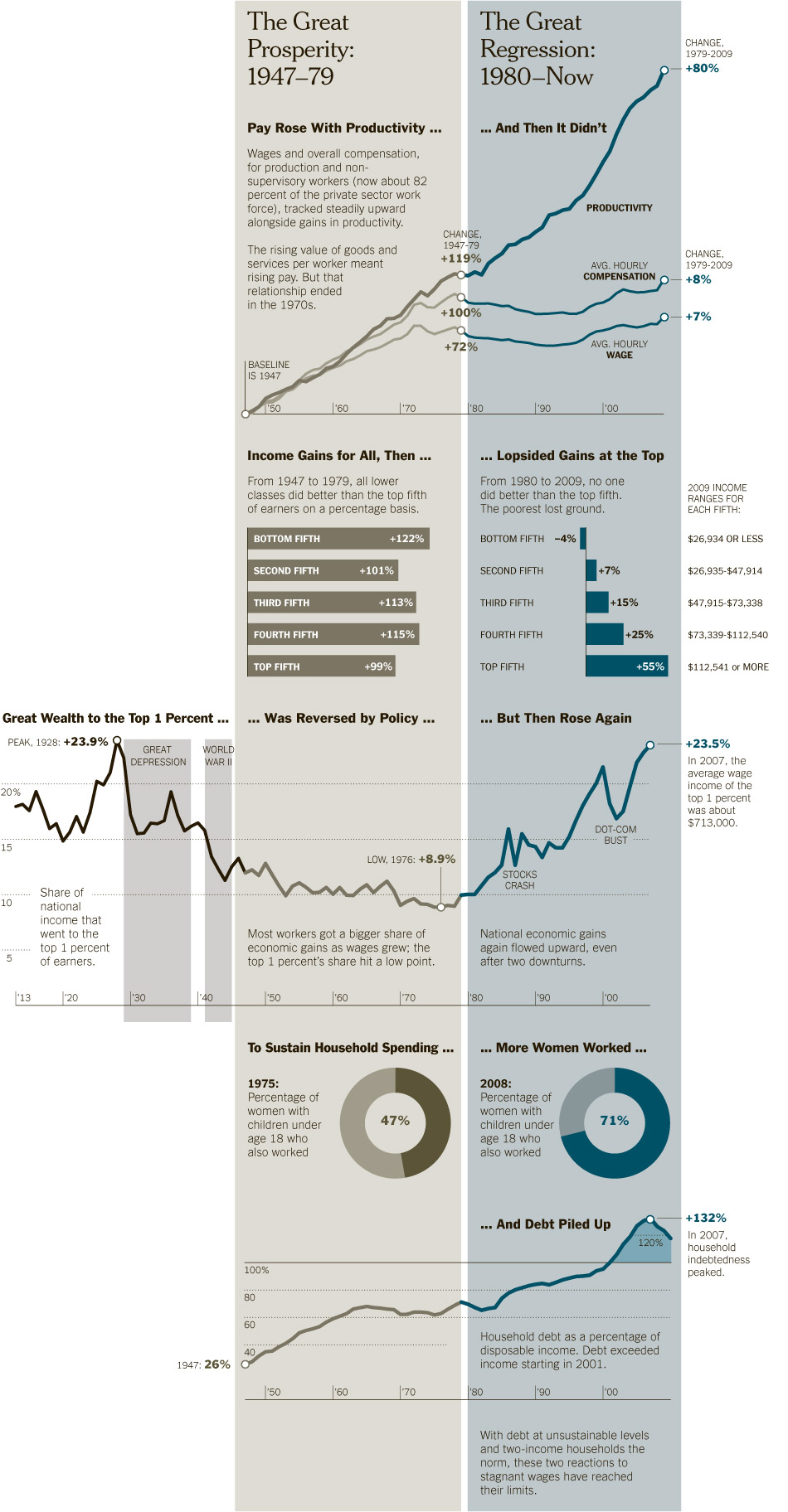
After nearly four years, the economy is finally back to where it was in late 2007. Sadly, the population is larger, the number of potential workers is larger, but the actual number of workers is smaller. While the total income of the whole population has recovered, the amount going to the bottom 99% is still less than what it was in 2007. The top 1% keep hoovering up any loose dollars and pocketing them which they, in their role of "job creators", then use increase their bank accounts and not create new jobs despite all the propaganda of the Republican ideologues.

As you can see, it is investment in equipment & software that is the engine of the recovery, not construction:

Click to Enlarge

Here is the bad news and the reason why the OWS movement is growing:

Click to Enlarge

Among his many shortcomings, the fact that Obama has failed to seriously address the housing crisis has made this Great Recession linger longer and deeper than it needed to have been. A great deal of needless suffering has been shouldered by the 99% because Obama refused to force the banks to swallow the costs of their bad decisions. Instead the bankers got to keep their big bonuses and nearly a trillion dollars of taxpayer dollars has gone to prop up the big Wall Street banks while 25 million are unemployed and 10 million have lost their homes. That is "economic justice" for the 1% but not for the 99%.

Rabu, 19 Oktober 2011

Sylvia Nasar's "Grand Pursuit"


This book is an intellectual history of economics with a focus on a handful of names: Karl Marx, Alfred Marshall, Beatrice Webb, Irving Fisher, Joseph Schumpeter, John Maynard Keynes, Friedrich Hayek, Joan Robinson, Milton Friedman, Paul Samuelson, and Amartya Sen.

As you can see, those choices are idiosyncratic. Most modern economists would not include Marx, Webb, and Robinson since they are off in the dead end of Marxist "economics". But for me they are part of the spice of this book. This isn't a text to teach you economics. It is really more of a history of personalities and circumstances. The stories are delightful. The sketches of economics are thin gruel, so don't come here to understand economic theory. Come to savour history, personalities, and ideas.

What I found delightful is that the book reinforced my prejudices. Economics is not a "science". It is a liberal art with the pretension of science through its mathematicization of its arguments. The formalism doesn't make the models and arguments any more right. They do provide a bit more formal clarity but they also lead to obscurantism with dithering over details and ridiculous "simplifying" assumptions. I had a mathematician as a friend who made this point by arguing about cows by first stating "consider a sphere". Yep... mathematics does some wonderful leaps in simplification to make the mathematics "tractable".

Here are some snippets to give you a feel for the writing style:
Before resuming his journey north to the Scottish highlands, Alfred Marshall, a twenty-four-year-old mathematician and fellow of St. Hohn's College in Cambridge, spent hours walking through factory districts and the surrounding slums "looking into the faces of the poorest people." He was debating whether to make German philosophy or Austrian psychology his life's work. These were his first steps away from metaphysics and the beginning of a dogged pursuit of social reality. He later said that these walks forced him to consider the "justification of existing conditions of society."

In Manchester, Marshall found the smoky brown sky, muddy brown streets, and long piles of warehouses, cavernous mills, and insalubrious tenements -- all within a few hundred yards of glittering shops, gracious parks, and grand hotels -- that novels such as Elizabeth Gaskell's North and South had led him to expect. In the narrow backstreets he encountered sallow, undersized men and stunted, pale factory girls with thin shawls and hair flecked with wisps of cotton. The sight of "so much want" amid "so much wealth" prompted Marshall to ask whether the existence of a proletariat was indeed a "necessity of nature," as he had been taught to believe. "Why not make every man a gentleman?" he asked himself.

...

He took great pains to demolish Socialists' claim that but for oppression by the rich, the poor could live in "absolute luxury." England's annual income totaled about £900 million, he told the women. The wages paid to manual workers amounted to a total of £400 million. Most of the remaining £500 million, Marshall pointed out, represented the wages of workers who did not belong to the so-called working classes: semiskilled and skilled workers, government officials and military, professionals, and managers. In fact, an absolutely equal division of Britain's annual income would provide less than £37 per capita. Reducing poverty required expanding output and increasing efficiency; in other words, economic growth.
One of the points that Nasar makes is that modern societies organized around liberal economic principles has unleashed productivity and wealth. But as I read the above I keep picturing the billionaire tycoons on Wall Street and the masses in the street with their Occupy Wall Street protests. Sure there has been progress, but the economic injustice is still just as bad. The greed and indifference is there which exacerbates the pain. The fact that the billionaires can buy the politicians means that nothing will ever change. The fact that the rich are pushing to cut education and social services while cutting taxes on the rich as their "solution" to the current Lesser Depression is very depressing.

Sylvia Nasar's story points out that the same humbug and foot-dragging that blocked a real solution to the Great Depression was very, very similar to the humbug and foot-dragging of today:
Despite his financial straits, damaged reputation, and advancing age, the sixty-five-year-old Fisher seemed more energized than depressed by the economic calamity. In 1932 he published an extraordinary number of scientific papers and newspaper pieces. He bombarded the Hoover administration and the Federal Reserve with advice and organized other economists to do the same. His chief objective was to convince President Hoover to take the United States off the gold standard, if not de jure then de facto by having the Federal Reserve do nothing to prevent the foreign exchange value of the dollar from falling. He met with the bankers at the Federal Reserve to urge them to adopt an aggressive program to buy bonds from the banks and the public in order to pump money into the banking system. To his frustration, the "Federal Reserve men thought it would be 'safer' if they waited!" as he later complained. "That waiting, in my opinion, cost the country the major part of the depression."

In January 1932, Fisher attended a second meeting of monetary experts at the University of Chicago. This time, he organized a telegram urging the president to permit the federal budget deficit to rise, pump reserves into the crippled banking system, slash tariffs, and cancel inter-allied debts. Thirty-two prominent economists from Chicago, Wisconsin, and Harvard universities signed the statement, in which Fisher pointed out that Sweden, Japan, and Britain were recovering after going off gold the previous year. The signatories reflected the extent to which Fisher and Keynes's view of the crisis with its emphasis on its global nature, monetary causes, forecasts of its future course, and the need for concerted monetary intervention had gained adherents. On the other hand, theirs was still a minority view.
Sadly, today Obama ignores neo-Keynesian solutions. He shows himself to be uneducated about economics and has surrounded himself with the same fanatical deregulation libertarian economists who created this Lesser Depression. There has been absolutely no progress in economic "science" in 80 years. The same humbug and "morality play" rationalizing goes on to protect bondholders at the expense of the 25 million unemployed, the 10 million who are losing their homes, the youth who have given up on education because it is too expensive, and those nearing retirement who are desperate because their savings are exhausted. It is a social disaster, but Obama is acting like a modern Hoover and the 2012 Republican presidential candidates would make Hoover look like a bleeding-heart liberal. Tragic.

Sylvia Nasar traces out Keynes' thinking:
As the Great Depression dragged on, Keynes's faith in the effectiveness of monetary policy ebbed further. By the time A Treatise on Money appeared, he was beginning to pose a theory of the causes of unemployment. Cambridge undergraduates were his first audience. The nub of the new theory was that, as he put it in an article published in the American Economic Review in December 1933, "circumstances can arise, and have recently arisen, when neither control of the short-rate of interest nor control of the long-rate will be effective, with the result that direct stimulation of investment by government is a necessary means."

In a severe depression, prices fell even faster than interest rates. So reductions in nominal rates did not prevent real rates from climbing. Once nominal rates fell to zero, there was nothing further that the central bank could do to make borrowing cheaper or to ease debt burdens and thus to end the depression -- with incalculable political consequences, what Keynes called The Liquidity Trap. As he had once observed, "The inability of the interest rate to fall has brought down empires." Once monetary policy was rendered ineffectual, the only option for shoring up demand was getting money into the hands of those who could spend it.

...

As Herbert Stein, the economist, pointed out, Keynes asked a very different question from the one posed by Hayek and Schumpeter. In explaining depressions, in terms of the preceding booms, the Austrians were trying to figure out how the economy had gotten there. Keynes was less interested in the genesis of slumps than in the more basic puzzle of how high unemployment and slack capacity could persist for long in a free market economy with unrestricted competition.

...

Thus what made the General Theory so radical was Keynes' proof that it was possible for a free market economy to settle into states in which workers and machines remained idle for prolonged periods of time -- that there were depressions that, unlike the garden-variety ones, were not brief and didn't end of their own accord as a result of falling prices and interest rates, or, at an extreme, that free market economies tended naturally to stagnate even when there were idle workers and machines available. In such depressions, unfreezing credit flows through monetary policy didn't provide a sufficient stimulus, because even zero-percent interest rates could not tempt businesses to borrow while prices were falling and there was [no] reason to think that demand would recover. The only way to revive business confidence and get the private sector spending again was by cutting taxes and letting businesses and individuals keep more of their income so that they could spend it. Or, better yet, having the government spend more money directly, since that would guarantee that 100 percent of it would be spent rather than saved. If the private sector couldn't or wouldn't spend, then the government had to do it. For Keynes, the government had to be prepared to act as the spender of last resort, just as the central bank acted as the lender of last resort.
This is the same intellectual landscape that has policy makers hung up today. Bernanke and the Federal Reserve have been too timid in using monetary policy and now the only tool left is fiscal stimulus, but you have right wing nuts screaming about "inflation!" and "debt!". Obama is too timid to properly stimulate the economy and instead falls into the trap of Hoover and FDR in 1937 of worrying about deficits and debts. They ignore the ruined lives and the lost production that can never be retrieved while the country stays mired in a depression. The arguments of 80 years ago are lost to policy makers today because they are illiterate about history and economics. Oh, and they are blinded by their ideology, an ideology bought and paid for by the billionaire ultra-rich who are quite happy to leave the system just as it is, a system that has let them exploit it for billions in personal gain. This is a tragedy for the bottom 99%. The top 1% are laughing, but the bottom 1% are paying in ruined lives... and they will also pay through taxes to cover the lost monies and even provide the billionaire bonuses for the frauds and cheats who created the mess. Sorrows heaped on woes, and smothered with injustice.

This is a good read and it is highly relevant. This book will give you useful background to understand the economic arguments of today and the tragedy that today is a maddening repeat of the 1930s.

Selasa, 04 Oktober 2011

Wisdom from the Great Depression

Here are words from Mariner Eccles, appointed Chairman of the Federal Reserve by FDR. His words then are applicable today:
It is utterly impossible, as this country has demonstrated again and again, for the rich to save as much as they have been trying to save, and save anything that is worth saving. They can save idle factories and useless railroad coaches; they can save empty office buildings and closed banks; they can save paper evidences of foreign loans; but as a class they can not save anything that is worth saving, above and beyond the amount that is made profitable by the increase of consumer buying. It is for the interests of the well to do – to protect them from the results of their own folly – that we should take from them a sufficient amount of their surplus to enable consumers to consume and business to operate at a profit. This is not “soaking the rich”; it is saving the rich. Incidentally, it is the only way to assure them the serenity and security which they do not have at the present moment.
The right wing Republican nuts of today are as hidebound and foolish as the right wing Republican nuts of the 1930s. In both cases they scream bloody murder about "class war" and want to protect the excessive incomes of the rich. But the rich have squeeze society to the point where the spending of the bottom 90% can't keep the economy afloat. Mariner Eccles made that point 80 years ago and it needs to be made again today.

Here is the wisdom that must be re-learned:
Before effective action can be taken to stop the devastating effects of the depression, it must be recognised that the breakdown of our present economic system is due to the failure of our political and financial leadership to intelligently deal with the money problem. In the real world there is no cause nor reason for the unemployment with its resultant dsestitution and suffering of fully one-third of our entire population. We have all and more of the material wealth which we had at the peak of our prosperity in the year 1929. Our people need and want everything which our abundant facilities and resources are able to provide for them. The problem of production has been solved, and we need no further capital accumulation for the present, which could only be utilised in further increasing our productive facilities or extending further foreign credits. We have a complete economic plant able to supply a superabundance of not only all the necessities of our people, but the comforts and luxuries as well. Our problem, then, becomes one purely of distribution. This can only be brought about by providing purchasing power sufficiently adequate to enable the people to obtain the consumption goods which we, as a nation, are able to produce. The economic system can serve no other purpose and expect to survive.
Obama has in power for nearly 3 years and still hasn't learned this lesson. Throw out Obama! The Democrats need a new leader. Somebody who understands that the purpose of government is to help people have hope ("change you can believe in") and a better, more prosperous future. Obama has failed to deliver. A new guy needs to be put forward in the hopes that they have the guts, the courage, the cojones, the intelligence, and the leadership to make the changes needed to bring about a better tomorrow.

Kamis, 29 September 2011

American Political Leaders Continue to Turn Down a "Free Lunch"

It isn't often that you see an economist identify a "free lunch" and tell you it isn't a scam, that it literally is like a $100 bill lying on the sidewalk waiting to be picked up. Sure there are right wing economists who would walk right by that $100 bill because they believe in "efficient markets" which assures them the bill can't be real because if it were then somebody would have already bent down and pocketed the free money.

Here is the opening of an excellent article by Brad DeLong pointing out a "free lunch" that Obama, the Republicans, and the Democrats are ignoring. They believe the following is like the $100 on the sidewalk. It can't be real otherwise somebody else (the "job creators" in Republican lingo) would have already bent down and grabbed it. But the "free lunch" is real. Here is DeLong spelling it out:
Former US Treasury Secretary Lawrence Summers had a good line at the International Monetary Fund meetings this year: governments, he said, are trying to treat a broken ankle when the patient is facing organ failure. Summers was criticizing Europe’s focus on the second-order issue of Greece while far graver imbalances – between the EU’s north and south, and between reckless banks’ creditors and governments that failed to regulate properly – worsen with each passing day.

But, on the other side of the Atlantic, Americans have no reason to feel smug. Summers could have used the same metaphor to criticize the United States, where the continued focus on the long-run funding dilemmas of social insurance is sucking all of the oxygen out of efforts to deal with America’s macroeconomic and unemployment crisis.

The US government can currently borrow for 30 years at a real (inflation-adjusted) interest rate of 1% per year. Suppose that the US government were to borrow an extra $500 billion over the next two years and spend it on infrastructure – even unproductively, on projects for which the social rate of return is a measly 25% per year. Suppose that – as seems to be the case – the simple Keynesian government-expenditure multiplier on this spending is only two.

In that case, the $500 billion of extra federal infrastructure spending over the next two years would produce $1 trillion of extra output of goods and services, generate approximately seven million person-years of extra employment, and push down the unemployment rate by two percentage points in each of those years. And, with tighter labor-force attachment on the part of those who have jobs, the unemployment rate thereafter would likely be about 0.1 percentage points lower in the indefinite future.

The impressive gains don’t stop there. Better infrastructure would mean an extra $20 billion a year of income and social welfare. A lower unemployment rate into the future would mean another $20 billion a year in higher production. And half of the extra $1 trillion of goods and services would show up as consumption goods and services for American households.

In sum, on the benefits side of the equation: more jobs now, $500 billion of additional consumption of goods and services over the next two years, and then a $40 billion a year flow of higher incomes and production each year thereafter. So, what are the likely costs of an extra $500 billion in infrastructure spending over the next two years?

For starters, the $500 billion of extra government spending would likely be offset by $300 billion of increased tax collections from higher economic activity. So the net result would be a $200 billion increase in the national debt. American taxpayers would then have to pay $2 billion a year in real interest on that extra national debt over the next 30 years, and then pay off or roll over the entire $200 billion.

The $40 billion a year of higher economic activity would, however, generate roughly $10 billion a year in additional tax revenue. Using some of it to pay the real interest on the debt and saving the rest would mean that when the bill comes due, the tax-financed reserves generated by the healthier economy would be more than enough to pay off the additional national debt.

In other words, taxpayers win, because the benefits from the healthier economy would more than compensate for the costs of servicing the higher national debt, enabling the government to provide more services without raising tax rates. Households win, too, because they get to buy more and nicer things with their incomes. Companies win, because goods and workers get to use the improved infrastructure. The unemployed win, because some of them get jobs. And even bond investors win, because they get their money back, with the interest for which they contracted.

So what is not to like? Nothing.
Go read the whole article.

The political "leadership" in America is a joke. These are political hacks more interested in grandstanding and playing ideological gamesmanship than in saving the ship of state from the shoal of depression and years of economic hardship. It is practically criminal that this is happening!

Senin, 26 September 2011

What Government Could & Should Do

The political right in the US keeps wanting to shrink government to a size where it can be drowned in a bathtub, but most people realize that government is critical to getting us out of the recession/depression we are living through.

Here is an interview with Michael Spence, a Nobel-prize winning economist:


He is dead right that government should focus on:
  • Fiscal stabilization

  • Growth

  • Employment
His views are the "sweet voice of reason" which is exactly what the politicians are ignoring. Spence thinks that slowly and eventually "the government" will finally wrap its mind around its responsibilities. From my perspective the right wing nuts in the US will ensure that no such reasonableness will be evident until after the 2012 election and only if the Republicans are decisively rejected by the electorate.

Sabtu, 10 September 2011

The New "Jobs, Jobs, Jobs" Obama

The economist and blogger Mark Thoma whose Economist's View blog has recorded his opinion of Obama's big "jobs" address to Congress. He tries to remain a good "team player" and emphasize the positive, but he is worried by a few things:
However, there are some concerns. First, the speech itself lost its focus on job creation toward the end. Instead of jobs, the speech talked about the deficit, red tape regulation, the need to accept painful cuts in social programs, and so on — all favorite GOP issues. If that’s an indication that the commitment toward job creation will be similarly derailed by these issues in the future, then that’s worrisome.

Second, and more importantly, I didn’t like the way the package would be paid for:
The agreement we passed in July will cut government spending by about $1 trillion over the next ten years. It also charges this Congress to come up with an additional $1.5 trillion in savings by Christmas. Tonight, I’m asking you to increase that amount so that it covers the full cost of the American Jobs Act. …

So we can reduce this deficit, pay down our debt, and pay for this jobs plan in the process.
Too many of the proposed budget cuts are front-loaded already, and this would likely make it worse. It would be much better to pay for the package when the economy is on better footing. Paying for a significant portion of the job creation bill immediately, e.g. in 2013 and 2014 (as would likely be a condition of it passing Congress), will offset some of the stimulus and make it less effective
Sadly, those who were sold in 2008 by candidate "The Audacity of Hope" Obama have discovered the 2011 president "I'm terrified of the Republicans" Obama. Nobody in 2008 thought they were voting in the 2011 model. They were duped. They were promised "change you can believe in" and ended up being delivered "whatever petty changes I can convince the Republicans to give me". So much for elections and for politicians. Obama ended up being a pig in a poke.

Fool me once, shame on you. Fool me twice, shame on me. Obama is going to find it very, very hard to gather those enthusiastic "hope" and "change you can believe in" crowds in 2012. I guess he will have to sell his campaign on fear: if you don't vote me in with my give the Republicans what they want but drag it out and make it painful, then you will be electing Republicans and they will sell your momma into slavery so they can give the rich folks one more big tax break.

Selasa, 06 September 2011

Finding Excuses

Here is a bit from an article by Martin Wolf at the Financial Times:
One objection – laid out by Harvard’s Kenneth Rogoff in the Financial Times in August – is that people will fear higher future taxes and save still more. I am unpersuaded: household savings have fallen in Japan. But there is a good answer: use cheap funds to raise future wealth and so improve the fiscal position in the long run. It is inconceivable that creditworthy governments would be unable to earn a return well above their negligible costs of borrowing, by investing in physical and human assets, on their own or together with the private sector….

Another noteworthy objection – grounded in the seminal work of Prof Rogoff and Carmen Reinhart of the Peterson Institute for International Economics in Washington – is that growth slows sharply once public debt exceeds 90 per cent of GDP. Yet this is a statistical relationship, not an iron law. In 1815, UK public debt was 260 per cent of GDP. What followed? The industrial revolution.

What matters is how borrowing is used…. Contrary to conventional wisdom, fiscal policy is not exhausted. This is what Christine Lagarde, new managing director of the International Monetary Fund, argued at the Jackson Hole monetary conference last month. The need is to combine borrowing of cheap funds now with credible curbs on spending in the longer term.
I especially like the jab of pointing out that the UK overcame its "big" debt by... initiating the Industrial Revolution. Yep, the future is full of promise. If only the leaders would lead instead of hiding in their inner sanctums terrified of what might be in the future.

Minggu, 04 September 2011

Small Facts... Often Ignored

From a post by John Mauldin at The Big Picture blog:

The US has roughly the same number of jobs today as it had in 2000, but the population is well over 30,000,000 larger. To get to a civilian employment-to-population ratio equal to that in 2000, we would have to gain some 18 MILLION jobs.
And this:

Note that simply to reduce the unemployment rate to 8% over two years at the lowest participation rate of 64% would require 157,000 jobs a month. If those jobs started showing up, the number of people looking for jobs would increase, thus increasing the “official” unemployment rate. Most of the numbers of required new jobs are simply not possible, if history is any guide. (This is a politician’s nightmare. It will be years before they can take credit for something they didn’t do.)

Here's what happens when right wing governments that push for "deregulation" allow the big Wall Street banks to do "financial engineering" and destroy everybody's retirement fund:


Click to Enlarge


And, of course, nobody from the Wall Street banks has gone to jail. They caused a $10 trillion implosion, but golly gee, nobody did anything wrong!


For those who like that facts in pictures and not words, here is a chart from a different post on The Big Picture blog.

Sabtu, 03 September 2011

A Simple, Cheap, No-Republicans-Involved Technique to Kick Start the US Economy

I've admired Robert X. Cringely for years. He's a smart dude with this fingers in many pies. My favourite is technology. He has been a top-rate technology reporter for InfoWorld then PBS and lately as a blogger. I read him all the time.


Now he has dazzled me again with a truly simple idea that won't cost the taxpayers any money (at least not initially and probably never much, certainly tens of times less that the TARP bailout for the banks) and will do an end run around the obstructionist Republicans. Read this post from his blog and weep. This is a great solution and should be done immediately:

Dear Barry,


As a nation, we’re out of time, money, and jobs. Despite hundreds of billions of economic stimulus the economy is still in the toilet facing a possible double-dip recession. The new mood of austerity in Washington suggests that more hundreds of billions won’t be available for further stimulus, nor should they be. It’s time to find better solutions that cost little or nothing to implement — solutions that can be directly imposed without having to seek permission from anyone. The foreclosure crisis needs to be addressed, as does the housing market. If solving those problems can also stimulate the economy, well that would be a win-win. If it could be done for no cost at all, that would be a frigging miracle. I think such a miracle is possible.


There are several goals here: 1) slow the pace of foreclosures which would not only keep people in their homes but also help the housing market in general to recover; 2) find a way for underwater homeowners stuck with mortgages at high interest rates to refinance at present very low rates, saving money in the process and creating origination fees for the mortgage industry; 3) give people lower house payments so they can spend the savings, boosting the economy, and; 4) do the whole thing elegantly and at no cost, as if by magic.


The way to do this is for Fannie Mae and Freddie Mac and the Federal Housing Administration and the Veterans Administration and any other government-sponsored mortgage programs you can name to waive the appraisal requirement on non cash-out refinance applications for owner-occupied homes under these programs.


The main problem with refinancing mortgages for underwater houses is the underwater part. And the extent to which homes are determined to be underwater is based on comparing the appraised value of the home to the amount being refinanced. If the mortgage is underwater, refinancing is a no-can-do, so we go through the monkey-motion of mortgage modification — programs that have generally been undermined by the mortgage servicers.


Efforts to help the housing market to this point have been expensive and not very effective. Frankly they’ve benefited mortgage investors and done little or nothing for homeowners.


The trick here is to stop moralizing and pointing fingers and just find a loophole that will allow 30 million mortgage holders to refinance their loans at lower rates. This isn’t a write-down or a bail-out. People will still owe more than their homes are probably worth, but they’ll owe it at current interest rates, not past rates. Their mortgage payments will be lower and they’ll be less likely to walk away from their homes or otherwise go into foreclosure. Their homes will come off the market more or less permanently, reducing the inventory of unsold homes which will inevitably lead to a firming of prices and possibly stimulating new home construction.


Just temporarily eliminate the appraisal requirement for federally insured mortgages. That’s it.


There is no legal requirement that there be an appraisal and, in fact, there is a long tradition in the mortgage business of appraisals not being required for homes that were recently bought or sold. The key is that the homeowner is not trying to take cash out of his house, just lower his interest rate and therefore his monthly payment.


So the Federal Housing Finance Agency would order that for the next 12 months all refinances of existing mortgages for owner-occupied homes under its constituent agencies and not involving cash out will not require an appraisal. The transaction comes down to exchanging a mortgage at a higher rate with one of a lower rate, that’s all. Millions of homeowners will go from 6-7 percent down to 3-4 percent, saving an average $300 per month in the process — the equivalent of a $100 billion economic stimulus for no real cost at all.


Understand that people will still effectively owe more than their homes are worth, so they won’t be able to sell them. But since their payments will be lower they also won’t want to sell them, at least not as much. Foreclosures will ease dramatically and everyone will feel happier. The banking industry will love it because they’ll still have their federal insurance on mortgages while enjoying an explosion of mortgage demand which will create new banking jobs.


Understand these aren’t modifications, they are re-fi’s. Nobody is losing anything.


Yeah, but aren’t we engaging in a ruse? How can this work? Won’t it end up costing the government a bundle?


Nope. Payments will be lower so people can afford their homes, but they’ll still be essentially trapped in those homes, though that’s okay. Eventually the market will recover (sooner because we’re doing this) and those homes will come out from underwater and can slowly go back on the market for resale.


It is simple, it would work, it requires no act of Congress or even a Presidential order. It can be implemented on Tuesday with an impact measurable on Wednesday. It won’t cost the government anything and everyone involved will be happy.


Run with it, Barry. Be a hero.

Americans should be flooding the White House with demands that this solution be instigated immediately. Obama needs to grow some balls and act like a real leader and lead.


I remember my history. When Teddy Roosevelt was refused funds to send the US Navy on a flag waving trip around the world, Roosevelt simply ordered the fleet to sea and sent them off (see this and this). He knew that when the fleet ran low on coal and needed refueling to get home, Congress would have to act. Why can't Obama show leadership like this to get around the idiotic obstructionist Republicans?

Krugman Bad Mouths Obama

Paul Krugman has lost all faith in Obama to do the economically sensible thing or to show any semblance of political leadership. From his blog at the NY Times:

I’ve actually been avoiding thinking about the latest Obama cave-in, on ozone regulation; these repeated retreats are getting painful to watch. For what it’s worth, I think it’s bad politics. The Obama political people seem to think that their route to victory is to avoid doing anything that the GOP might attack — but the GOP will call Obama a socialist job-killer no matter what they do. Meanwhile, they just keep reinforcing the perception of mush from the wimp, of a president who doesn’t stand for anything.


Whatever. Let’s talk about the economics. Because the ozone decision is definitely a mistake on that front.


As some of us keep trying to point out, the United States is in a liquidity trap: private spending is inadequate to achieve full employment, and with short-term interest rates close to zero, conventional monetary policy is exhausted.


Click to Enlarge


This puts us in a world of topsy-turvy, in which many of the usual rules of economics cease to hold. Thrift leads to lower investment; wage cuts reduce employment; even higher productivity can be a bad thing. And the broken windows fallacy ceases to be a fallacy: something that forces firms to replace capital, even if that something seemingly makes them poorer, can stimulate spending and raise employment. Indeed, in the absence of effective policy, that’s how recovery eventually happens: as Keynes put it, a slump goes on until “the shortage of capital through use, decay and obsolescence” gets firms spending again to replace their plant and equipment.


And now you can see why tighter ozone regulation would actually have created jobs: it would have forced firms to spend on upgrading or replacing equipment, helping to boost demand. Yes, it would have cost money — but that’s the point! And with corporations sitting on lots of idle cash, the money spent would not, to any significant extent, come at the expense of other investment.


More broadly, if you’re going to do environmental investments — things that are worth doing even in flush times — it’s hard to think of a better time to do them than when the resources needed to make those investments would otherwise have been idle.


So, a lousy decision all around. Are you surprised?
It is amazing to me that back in 2008 when America elected Obama there were such high hopes. I had read his books. I liked the arc of his career. He was obviously intelligent. He seemed to have a deft political touch. He claimed to be a real fan of Abraham Lincoln and saw himself as coming to play a Lincoln-esque role in a deeply divided country. It sounded so very good.


Then he took office and he failed to carry through on promises. Lots of little things left his partisans puzzled. He seemed oddly passive in the face of great problems. He seemed obsessive about "reaching out" to Republicans while ignoring his base. He "led" by following. He left to Congress the task of framing the great programs that would save the country. He frittered away time. He was unresponsive to the great suffering in the land. Amazing.


I, like Krugman, have reached the end of my rope. I expect nothing good out of Obama. I really would like to see the Democrats nominate somebody else to run 2012. He will be a disaster if he wins in 2012. He won't be as great a disaster as a Republican victor, but he will be a disaster. I'm not sure America can survive with another 4 years of Obama. That will have been 8 disastrous years under Bush and 8 frittered away, rudderless, falling short years under Obama. I'm not sure the country has the remaining internal resources to wait out this string of bad presidencies until 2016.


Here is Brad DeLong's disillusionment with Obama:

I remember being told that in January 2001 Larry Lindsey had showed up at the Council of Economic Advisers' office in the Eisenhower Executive Office Building and said "Well, the people who understand economics are back in charge!", and at the time I thought that Larry's belief that George W. Bush and his administration in any sense "understood" economics was the most pathetic and self-delusional thing that I had heard. But now I think of my confidence in December 2008 and January 2009 that the Obama administration understood that you needed not economic policies that sounded good and polled good but economic policies that actually worked, and I wince.

Go read the full post to get specifics of his disillusionment with regard to Obama's fixation on austerity.

Selasa, 30 Agustus 2011

US Politicians: Fumbling in the Dark

Here are some bits from a good article by Mark Thoma in The New Republic:

As the Great Recession drags on and on, it’s natural to wonder if we will ever get back to normal. Why is the recovery from this recession taking so long? Why was the recovery from other severe recessions, for example the 1982 recession where unemployment reached 10.8 percent, so much faster? Part of the answer is that we are experiencing a “balance sheet recession,” and this type of downturn is much harder to recover from than the other types we have had in recent decades. But poor policy is also to blame. Unfocused stimulus packages don’t get to the root of the problem, and short-term spending cuts are counter-productive. Instead, we need policies that do a better job of targeting the specific problems associated with balance sheet recessions. There are several things policymakers could do to address this, and each would help to improve the economic outlook.


...


Historically, the recessions that are the hardest to recover from are those caused by collapsing stock and housing bubbles. When a fall in stock and housing prices wipes out retirement, education, equity, and other savings, the balance sheet losses can’t be recouped overnight. It can take years to recover what is lost. Examples of balance sheet recessions such as Japan’s “lost decade” in the 1990s and the Great Depression of the 1930s show how hard it can be to recover from this type of recession. More generally, recent work by economists Carmen Reinhart and Kenneth Rogoff shows that balance sheet recessions are “followed by a lengthy period of retrenchment that most often … lasts almost as long as the credit surge.”


But these examples also show something else: how costly poor policy can be. A slow, “lost decade” recovery like we are currently on our way to experiencing is not inevitable. The speed of the recovery from a recession depends critically upon how monetary and fiscal policymakers react, and a policy tailored toward the specific type of recession hitting the economy can shorten the recovery time considerably. One of the main reasons the outlook for our economy is so poor is that policymakers have done a poor job of matching the policies they put into place to the type of recession we are experiencing.

Go read the whole article to find out what remedies Mark Thoma proposes.


I'm utterly shocked by how Obama has shown himself indifferent to solving the economic mess. He was quick to pick up and extend the Bush bailouts for banks. But he has done nothing for main street and home owners. Last time I looked he was elected under the Democratic ticket, but he sure behave's like a Republican. He acts like a banker's best friend. If you've watched the film It's a Wonderful Life, Obama acts like Henry Potter is his best friend and role model. He should be acting like George Bailey (James Stewart) trying to save the community, but instead Obama's only concern seems to be to save the big banks and to heck with everything else.